Bags over my shoes
Bags over my shoes
We Didn’t Know We Were Poor
Chapter One
I remember happiness in my early years. I was the youngest of four: two brothers and a sister. We didn’t have much, but we had each other.
My mother went through a string of relationships. The only time we truly had her attention was when she was single. The rest of the time, we raised ourselves.
I probably got the most affection. With sandy hair, big brown eyes, and a grin that could steal hearts, I suppose I was privileged in my own small way.
The outdoors became our escape. Freedom lived in the spaces between the streets and the fields. My eldest brother, Jamie, we called him Jay, mostly looked after me.
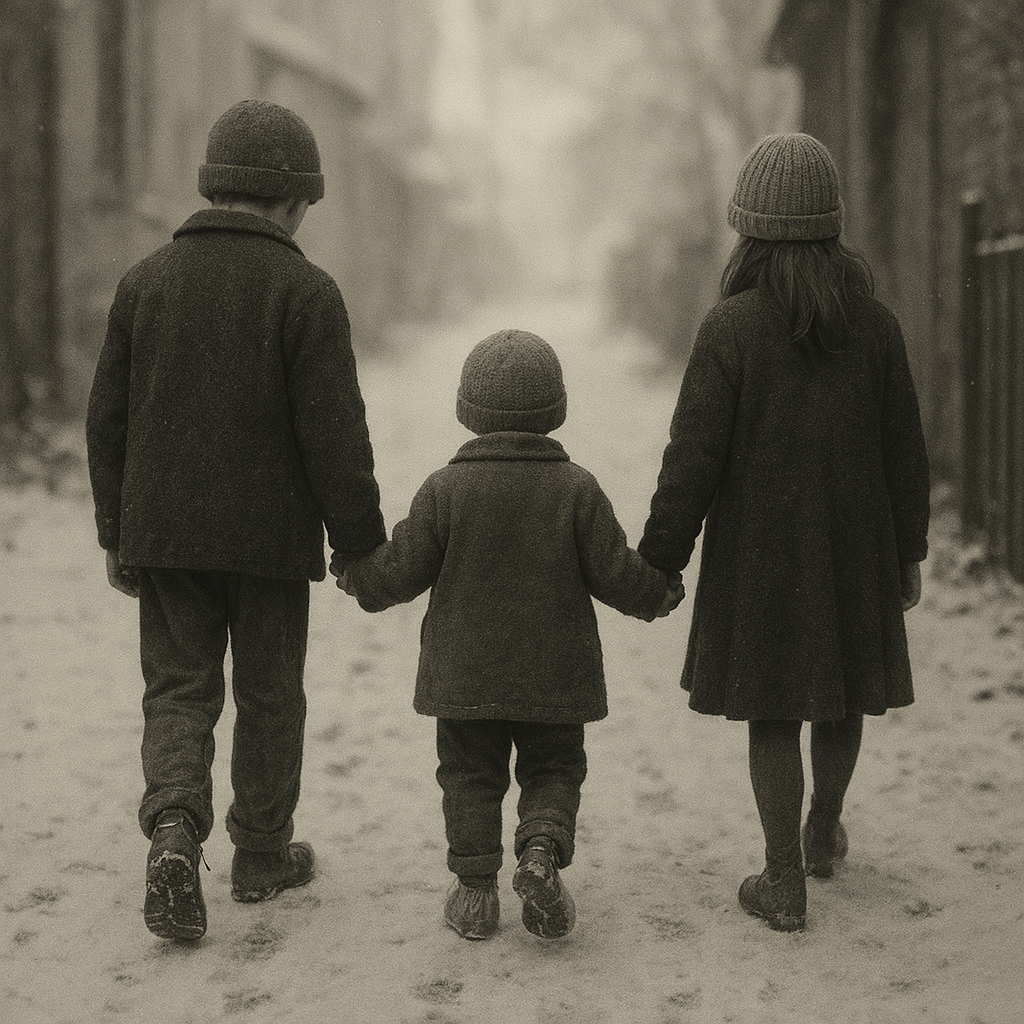
One of my earliest memories is of the small house where my sister’s room had a sloped ceiling. One Christmas, it snowed. I cried when I had to wear plastic bags over my shoes to play outside.
Father Christmas had given us toy guns, the kind with red cap rings that snapped when fired. We played cowboys and Indians, dying again and again in the snow, laughing as the caps went snap, snap, snap.
I’d also been given a blue inflatable chair, shaped like a smiling lion. It didn’t last long. My brother Sam, closest in age to me, stuck pins in it. My mother said it was jealousy. We were rivals in the way only young siblings can be.
I was four or five, so the details blur.
But I remember the cold.
I remember hiding behind that same smiling lion chair while my mother’s boyfriend hit Jay.
The sound came first, the thud, then Jay’s breath catching. I didn’t understand what I was seeing, only that something safe had broken. We were living in the man’s house, though I only learned that years later.
Later that winter, while he worked on his car out front, we slipped out the back, through the alley between the terraced houses. The snow was soft and soundless. I remember Jay’s hand around mine, stars lighting up the silent sky, and the darkness fading behind us.
We made our way through the white silence to a women’s refuge we would come to know as the battered wives’ home.
I don’t remember the journey itself or the arrival. Maybe I was sleeping.
The refuge was full of women and children, noise and motion everywhere. I once walked straight into a lamp post, and another time caught my fingers in the swinging doors to the TV room.
Sam’s temper sometimes got the better of him. Once, he threw a pair of scissors at one of the mothers.
My mother was changing too. Some nights, she and Lisa would go out dancing, returning late, laughing. I remember one evening she came home a little drunk, waking us by throwing handfuls of pennies across the room for us to catch.
She loved to dance and sing. She was beautiful, with long, dark curls framing eyes that lit up every room she entered. Once, she even won a competition dressed as Wonder Woman.
I thought she was perfect.
We went to the local school, but we didn’t fit in. Kids laughed at our clothes and called us names, but it didn’t bother me much. During breaks, the four of us would meet by a log pile and play together like we always had.
One afternoon, we saw crates of fruit outside the grocer’s next to the refuge. We thought they were being thrown away, so we took them all of them.
The mothers laughed, even if the grocer didn’t. In our world, it was a feast.
It wasn’t the first time we assumed things were free. My sister found a key to a cabin in the back garden, full of old clothes and toys. The women praised us as they rummaged through the piles, thrilled by the unexpected treasure, just as we were.
The next day, the staff scolded them. The items had been donated to raise money for the refuge. Everyone was told to put everything back, but I don’t think that happened.
We were poor, though we didn’t know it, not really. Hunger came and went, but sharing was constant.
At the refuge, I slept in a cot in a room we shared with another family. The mother, Lisa, had two boys: Tom and Daniel. Tom was my age, and we became good friends.
Once, after being told off for something I don’t remember, we decided to run away. We packed toys into a black bin bag and climbed over the back fence. The snow crunched softly under our shoes, our first taste of freedom, until an old woman stopped us and marched us straight back to the front of the house.
I remember an Easter egg hunt. My siblings were allowed to go, but I wasn’t. I cried until they let me come. Jay looked after me, like he always did.
The hunt was in the woods. Jay made sure I got some chocolate eggs, including a small one in a porcelain egg cup. I loved it, and I still think of it now, the cool porcelain against my palms, the sweetness of belonging.
Eventually, our time at the refuge ended. The next house would teach me something new about the world, and about who I was becoming.
Sometimes, when I think back, I still see that blue lion’s smile; bright, fragile, and already deflating.
Chapter Two
Before the refuge, I have one clear memory of my grandparents. We lived a few doors down from them. I remember being alone in the house, crying as my mother failed to answer me.
I stood at the front window, sobbing, when I saw my grandparents walking past. When they noticed me, they rushed to the door and took me back to theirs.
My grandma held me and gave me a chocolate bourbon biscuit. They always had biscuits, custard creams and bourbons. My favourite. But you were lucky if you found one left; they were everyone’s favourite.
Even now, I think of biscuits as comfort. As safety.
My mum had gone shopping and had apparently left me at home. I’m told she did this often. She had a telling-off, of course. My mother was young, and four children couldn’t have been easy. She fell in love easily, but what man is truly able to take on four children?
I always knew my father had left when I was a baby. My siblings had a different father, but it made no difference to me. We were a unit. Jay, especially, filled whatever space might have been there.
I don’t remember the move itself, but I remember the house. It was an end-terrace with front and rear gardens, backing onto woods, farms, and a reservoir. The land behind it felt endless.
It became our playground.
I remember my first day at school. Before that, I’d spent a few weeks at home alone with Mum while she cleaned and cried to sad love songs on the radio. I felt her sadness without understanding it.
When I walked through the school gates, I cried. I felt abandoned, as though I were being left behind.
Would my mother come back for me?
Every child’s quiet fear.
There are small moments that still feel warm. Being bathed in the kitchen sink, sunlight pouring through the window and dazzling my skin. Cold mornings, cautiously slipping one leg out from under the blankets to test the air.
My brothers and I shared one room. Sam and I slept in a bunk bed that collapsed once beneath us. Sam screamed, but he wasn’t hurt. After the shock passed, we laughed.
Some mornings, I woke to the sound of everyone in the kitchen. I would sit on the last step until my mother appeared and scooped me up, carrying me to breakfast.
We often had bread and milk, warmed in a saucepan with sugar.
No one ever complained.
We had no cooker for a while, so the open fire became our stove. Soup simmered in pans. Toast hovered over flames. She made shortage feel like an adventure.
Summer came quickly. We built dens, climbed trees, and swam in the river. We left home in the morning and returned when the streetlights came on. Freedom meant being unnoticed.
Mum started going out clubbing with Lisa from the refuge. She left us at home. My sister sometimes said the house was haunted, that she heard noises from the garden and the narrow path down the side.
I think now it wasn’t ghosts she feared, but the quiet.
My mother had another boyfriend, French. Jean-Jacques. Once, he danced naked in the rain and made us laugh. For a long time, I thought that’s what French people did. Like most things in our lives, it didn’t last.
At school, I was doing well. I loved to paint. When it was my turn to run the crisps trolley, I took the money so I could buy crisps like everyone else. My mother was called to the school. She was ashamed of me. I knew it, but I didn’t understand why, and it hurt.
Between my mother’s disappearances, we were a family again. We played board games. She hated losing. Sometimes we shared a bar of chocolate by the fire, breaking it carefully into pieces.
Then my mother found religion.
Apart from church on Sundays, not much changed at first.
Neighbours came and went. There was always someone smiling, someone kind to me. I was the youngest. Attention came easily.
I didn’t yet know why that mattered.
But I was learning how to be seen.