
Abstract
The Sator Square is one of the most enduring and enigmatic symbolic artefacts of antiquity. Despite centuries of linguistic, theological, and symbolic interpretation, no proposed translation has achieved consensus or explanatory closure. This essay argues that the persistent interpretive failure is not accidental. The Sator Square was not constructed to transmit propositional meaning but to demonstrate a condition of structural invariance. Read through the lens of filtration, the square functions as a maximally constrained symbolic lattice that remains coherent under reversal, rotation, and re-ordering. Its “meaning” lies not in what it says, but in what it shows: the pre-semantic conditions under which transformation can occur without loss of coherence.
1. The Problem of Interpretation
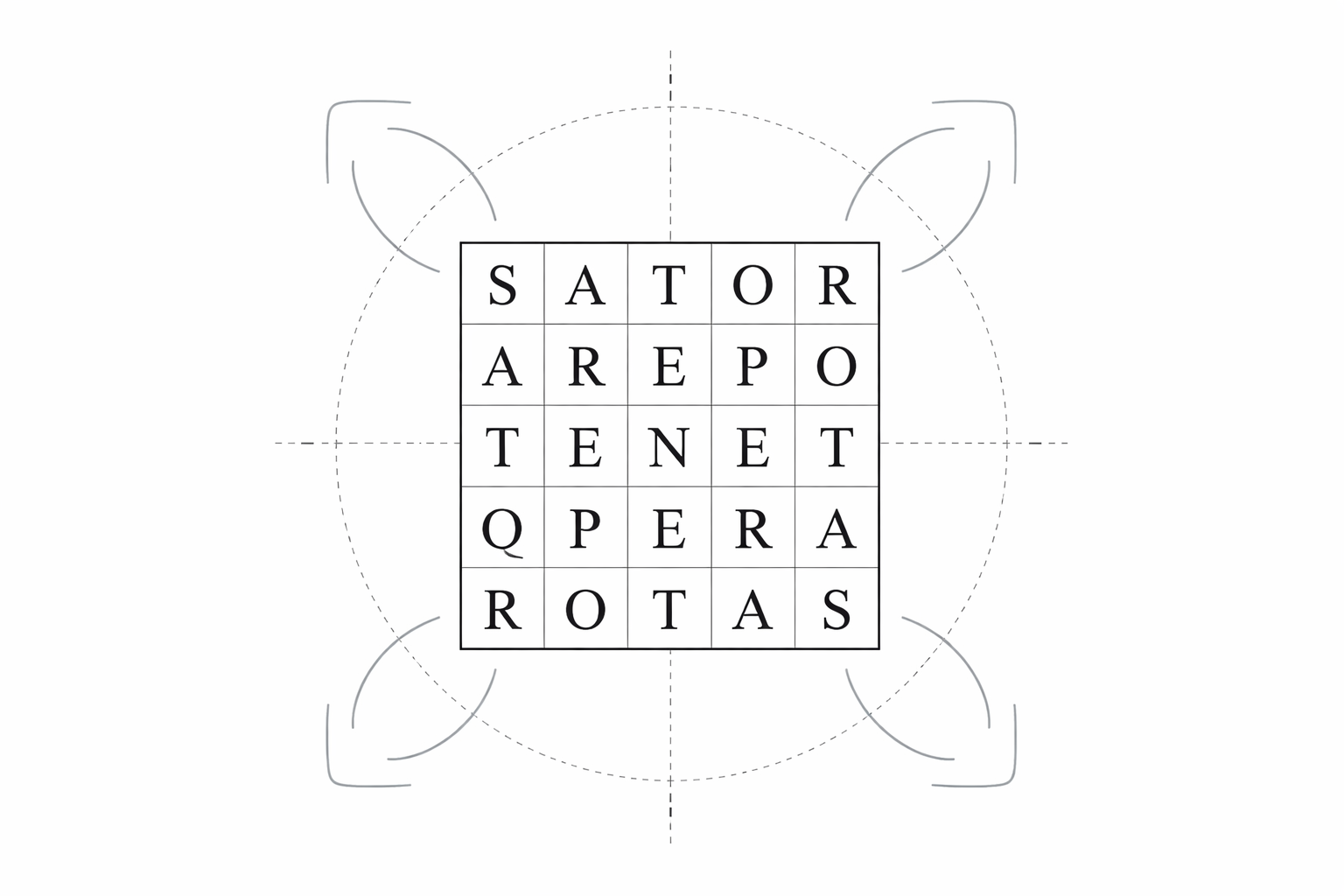
The Sator Square
S A T O R
A R E P O
T E N E T
O P E R A
R O T A S
has been discovered across the Roman world and reused across centuries. Scholars have attempted to understand it as:
- a grammatical Latin sentence,
- a cypher,
- a Christian cryptogram,
- a magical charm,
- or a symbolic cosmology.
Each of these approaches succeeds locally and fails globally. Literal translations are syntactically strained. Symbolic interpretations proliferate but do not converge. Theological overlays explain later reuse but not original construction.
The persistence of the square, coupled with the failure of decisive interpretation, suggests a category error: the assumption that the square is primarily linguistic.
This essay proposes a different starting point. Rather than asking what the square means, we ask what kind of object it is.
2. Structural Properties of the Square
Independent of interpretation, the Sator Square exhibits several objective properties:
- Bidirectional invariance
It reads identically left-to-right, right-to-left, top-to-bottom, and bottom-to-top. - Rotational symmetry
No orientation is privileged. Direction does not matter. - A single stabilizing center
The central word, TENET (“holds”), remains invariant under all transformations. - A constrained symbol set
Each term appears exactly where required for global coherence. No element is free to vary independently.
These properties are not incidental. They define a structure that actively suppresses divergence. The square is not merely symmetric; it is closed.
3. Why Translation Fails
Attempts to translate the square treat it as a sentence whose meaning is encoded in lexical content. This approach runs into immediate difficulties, most notably the presence of AREPO, a word unattested elsewhere in Latin.
From a linguistic perspective, AREPO appears anomalous. From a structural perspective, it is essential.
AREPO does not propagate meaning elsewhere in the square. It functions as a non-semantic boundary token: present, necessary, but inert. Its role is not to contribute content, but to allow closure without destabilisation.
This suggests that semantic richness was deliberately sacrificed in favour of structural stability. The square is optimised not for expressiveness, but for invariance.
4. The Whirlwind Interpretation (and Why It Partly Works)
Some interpreters have proposed that the square encodes dynamic phenomena such as whirlwinds, vortices, or cyclic flows. This intuition is not arbitrary. Several of the square’s terms cluster around motion and effort:
- ROTAS – wheels, turns
- OPERA – work, exertion
- TENET – holding, maintaining
Whirlwinds are visible examples of systems that process continuous inflow, perform work, export dissipation, and remain temporarily stable. In other words, they are striking instances of bounded dynamic persistence.
The weakness of the whirlwind interpretation is not that it is wrong, but that it is incomplete. The square does not depict a whirlwind. It lacks directionality, gradients, or flow paths. What it encodes instead is the condition under which whirlwinds, and many other persistent systems, can exist at all.
5. Filtration as the Unifying Explanation
Filtration provides a framework for understanding this condition.
In filtration, a system persists by:
- allowing variation and transformation,
- while selectively constraining divergence,
- and exporting what cannot be integrated.
Under this view, the Sator Square is not a message about a particular phenomenon. It is a symbolic demonstration of bounded transformation: work and motion held together by constraint, without collapse into noise or rigidity.
The square shows, in static form, what filtration achieves dynamically.
This explains why:
- linguistic readings partially work but never close,
- symbolic overlays attach easily but do not exhaust it,
- and physical analogies recur across domains.
All are inhabiting the same underlying structure.
6. Why Meaning Stops Here
The Sator Square contains no internal contrast that forces resolution. There is no decision, no narrative sequence, no accumulation of residue. Because nothing needs to be decided, no privileged interpretation emerges.
At this level of constraint, “is” and “and” collapse into the same relation. Identity and conjunction do not oppose one another because opposition itself is filtered out.
This is why the square feels timeless, complete, and resistant to explanation. It is not unfinished. It is saturated.
7. What the Square Ultimately Expresses
The Sator Square does not say something in the usual sense. It demonstrates a condition:
Only that which holds its own transformations can persist.
This is not a moral claim, a theological doctrine, or a scientific proposition. It is a structural truth that precedes all three.
Conclusion
The enduring power of the Sator Square lies not in hidden meaning, but in visible constraint. It is an artefact that shows how structure can persist independently of interpretation, and how meaning arises only after stability is secured.
Rather than asking what the square was meant to say, we should recognise what it was built to do: hold.
In that sense, the square does not explain the world.
It explains why explanations are possible at all.
Leave a Reply