We often talk about intuition as if it were magic, a mysterious signal from the future whispering through the fog of the present.
But what if it’s not the future calling at all?
What if intuition is the past remembering itself?
“The intuitive mind is a sacred gift and the rational mind is a faithful servant. We have created a society that honors the servant and has forgotten the gift.”
–Albert Einstein
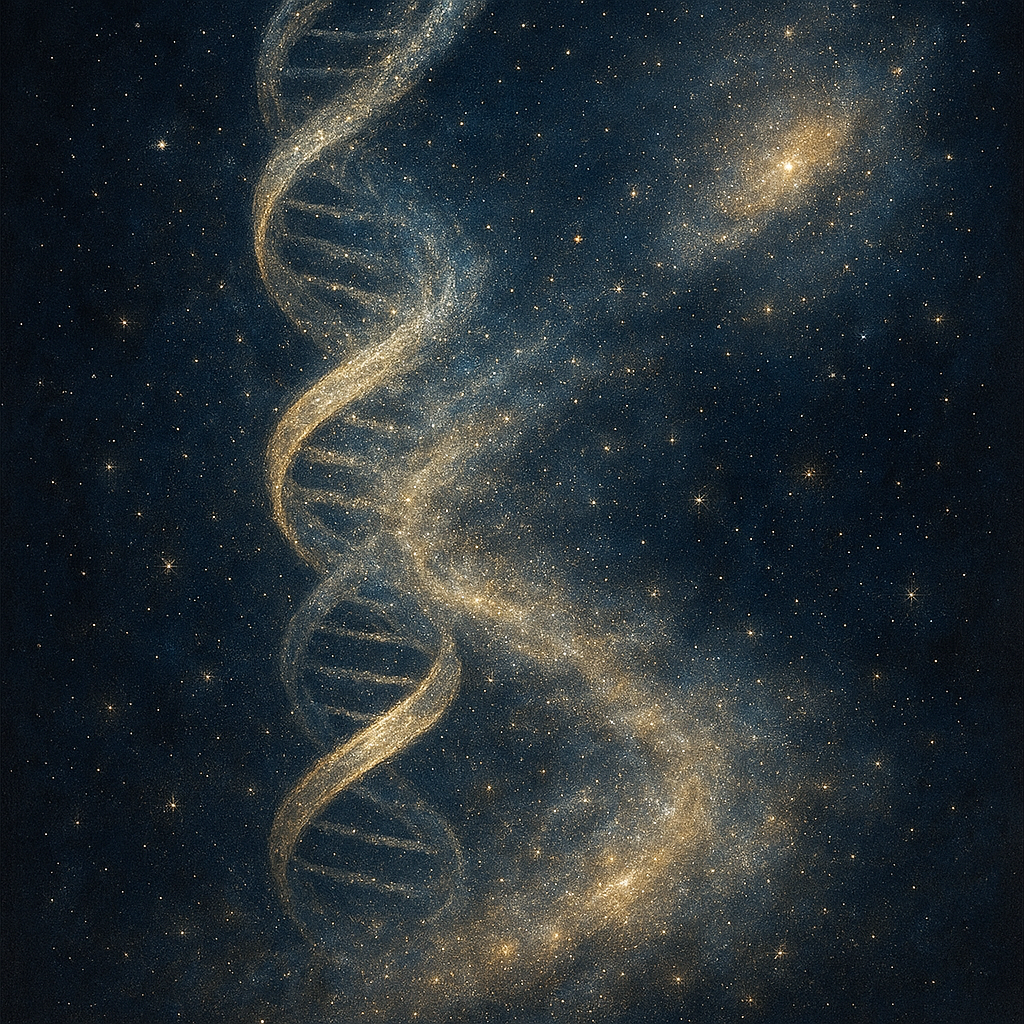
The DNA of Memory
Every living system carries its history within it. As evolutionary biologists like Richard Dawkins and Eva Jablonka have shown, DNA is not just a code of survival, it’s a record of adaptation, a living memory of how life has responded to the world before.
When we feel something is “right” or “wrong” without being able to explain why, it may not be foresight. It may be the echo of generations past; instincts and recognitions stored in our biology.
Intuition, then, is not prophecy. It’s memory awakening.
Pattern Recognition: The Brain’s Hidden Forecast
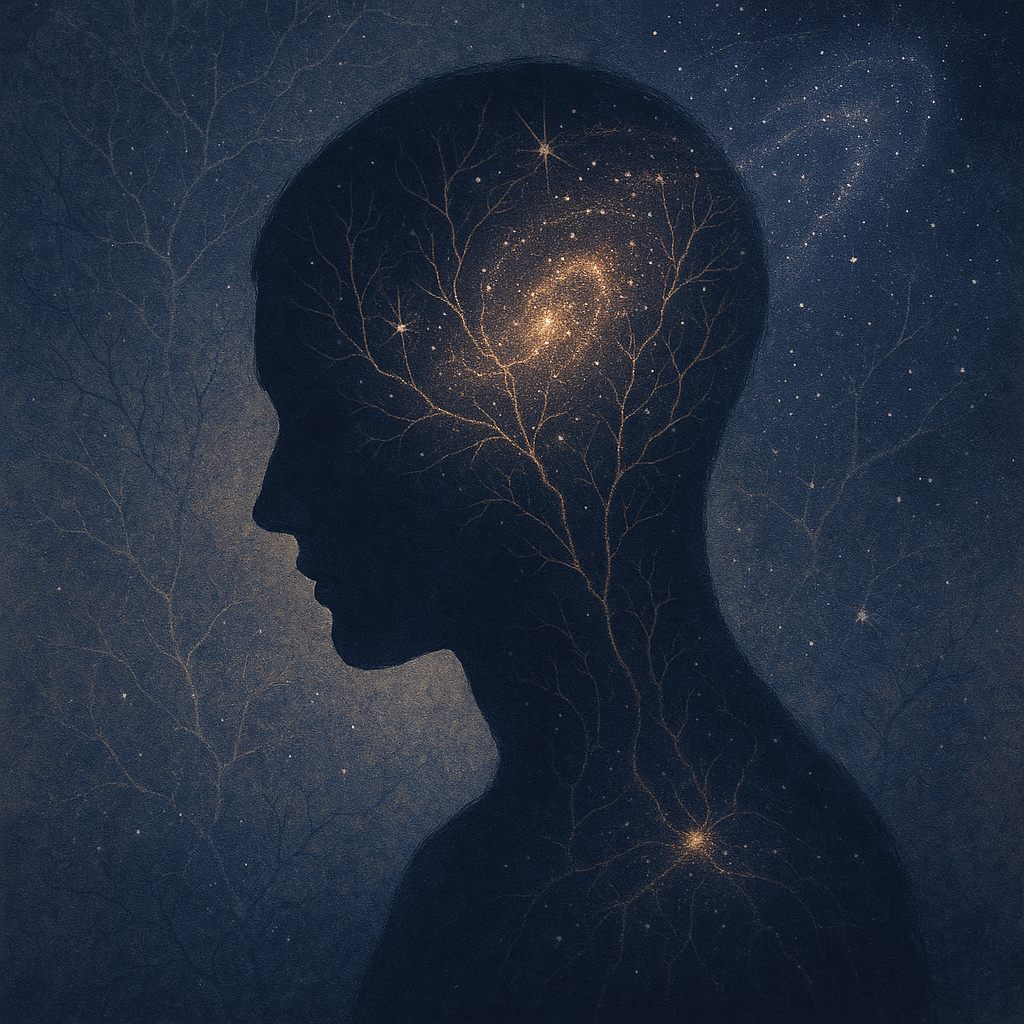
The brain doesn’t predict by seeing the future; it predicts by comparing the present to the familiar.
Neuroscientists such as Karl Friston – through his Free Energy Principle – and cognitive theorists like Daniel Kahneman have shown that our minds constantly minimise uncertainty by matching the present to prior experience.
We don’t “see ahead”; we remember forward, projecting probability from pattern.
That’s why a “gut feeling” can be right even when logic hesitates. The pattern fits, and the body remembers.
We mistake this for precognition, but in truth, it’s probability shaped by memory; what Gary Klein calls recognition-primed decision-making.
The Inner Lens of Discovery
If we look at the great masters and inventors, their genius did not come only from studying nature’s patterns, it came from reflecting them.
They understood that discovery requires more than observation; it demands the removal of bias, the stilling of noise within.
Leonardo da Vinci looked at the flow of rivers and saw the anatomy of the human body. His flying machines and mechanical designs were not born from imagination alone but from recognising repeating forms in life itself; movement, balance, flow.
Nikola Tesla described his inventions as “appearances of complete solutions” in flashes of vision, not coincidence, but the mind’s deep alignment with the rhythms of energy and vibration.
Albert Einstein credited his greatest insights, like relativity, not to mathematical deduction but to intuition and visualisation, what he called “combinatory play.” He sensed the hidden symmetry between time, motion, and perception long before proving it on paper.
Even the simplest innovations, like the chain reaction of the domino effect, mirror nature’s own process: small causes amplifying through connected systems, a physical metaphor for how thought, discovery, and evolution unfold.
Their intuition was not mystical but deeply internal, a disciplined sensitivity to the truth already written in the structure of life itself.
By clearing perception, they aligned with the same process that shapes evolution: the pattern-seeking intelligence embedded in our DNA.
To see clearly, they had to become part of the process they studied, not separate from it.
The Daemon Within
Many of these masters described their inspiration as if guided by something unseen, what the Greeks called a daemon or a muse.
Socrates spoke of an inner voice that whispered restraint and wisdom. Da Vinci, Tesla, and Einstein all referred to their ideas arriving in moments of clarity, as if received rather than invented.
Whether we call it intuition, daemon, or genius, the experience is the same: the alignment of human perception with the deeper intelligence of nature, the code within life itself.
The Memory of Life Itself
Even in our daily lives, we recognise patterns without realising it, a familiar face in a crowd, a gesture we’ve never seen yet somehow understand. These are not miracles of the moment; they are echoes of something ancient.
Beneath our awareness lies billions of years of encoded experience, layers of trial, error, and adaptation written into every strand of DNA and RNA. Life has been learning all along.
When we “see before it happens,” we are not predicting, we are remembering. We are drawing from the deep rhythm of existence, connecting shades and patterns that life itself has rehearsed through time.
Yes, humanity is young, only a few thousand years awake, but the living systems we are built from have known this eternity, as Ilya Prigogine described: the endless cycle of order and decay, of creation and entropy, forever reorganising itself into new complexity.
Intuition is not foresight, it is participation in that eternal rhythm of remembering and renewal.
The Shadow of Intuition
Yet intuition is not always clear.
Because it arises from memory, biological, emotional, and experiential, it can carry the distortions of our past.
Trauma, fear, and negative experiences leave their imprint on the nervous system, shaping how we perceive and respond.
As Daniel Kahneman notes, our thinking is prone to “fast errors”, intuitive judgments that feel certain but are subtly biased.
And Carl Jung reminds us that the unconscious is not only creative but also shadowed: it holds both wisdom and wound.
When the past is unresolved, intuition can become biased, a reflex of protection rather than perception.
In those moments, what feels instinctively true may actually be an echo of hurt, replayed through the body’s memory.
This doesn’t make intuition unreliable, it reminds us that self-awareness is part of clarity.
To refine intuition is to heal perception: to recognise which signals come from wisdom and which from wound.
The Real Magic: Integration
To sense patterns this deeply, the brain must hold multiple states in tension, instinct, emotion, and logic all communicating at once.
When they align, we experience flow; when they conflict, confusion.
Consciousness evolves by learning to balance these states, a principle echoed from Jung’s archetypal psychology to Antonio Damasio’s neuroscience, not by escaping time, but by integrating it.
“The past doesn’t just live behind us, it lives through us, shaping what we call instinct, intuition, and insight.”
So perhaps intuition isn’t a supernatural gift, but the most natural one of all:
the body remembering what the mind has not yet learned.
Further Reading
– Damasio, A. The Feeling of What Happens (1999)
– Kahneman, D. Thinking, Fast and Slow (2011)
– Klein, G. Sources of Power: How People Make Decisions (1998)
– Friston, K. The Free Energy Principle (2010)
– Prigogine, I. & Stengers, I. Order Out of Chaos (1984)
– Jablonka, E. & Lamb, M. Evolution in Four Dimensions (2005)
– Dawkins, R. The Selfish Gene (1976)
– Jung, C. G. Man and His Symbols (1964)
🌐 The Measured Mind
Exploring the science of balance in mind and society.
themeasuredmind.cwenglish.com
#Consciousness #Intuition #Neuroscience #Evolution #Entropy #TheMeasuredMind
Leave a Reply