
-by Carl Samuel Warwick
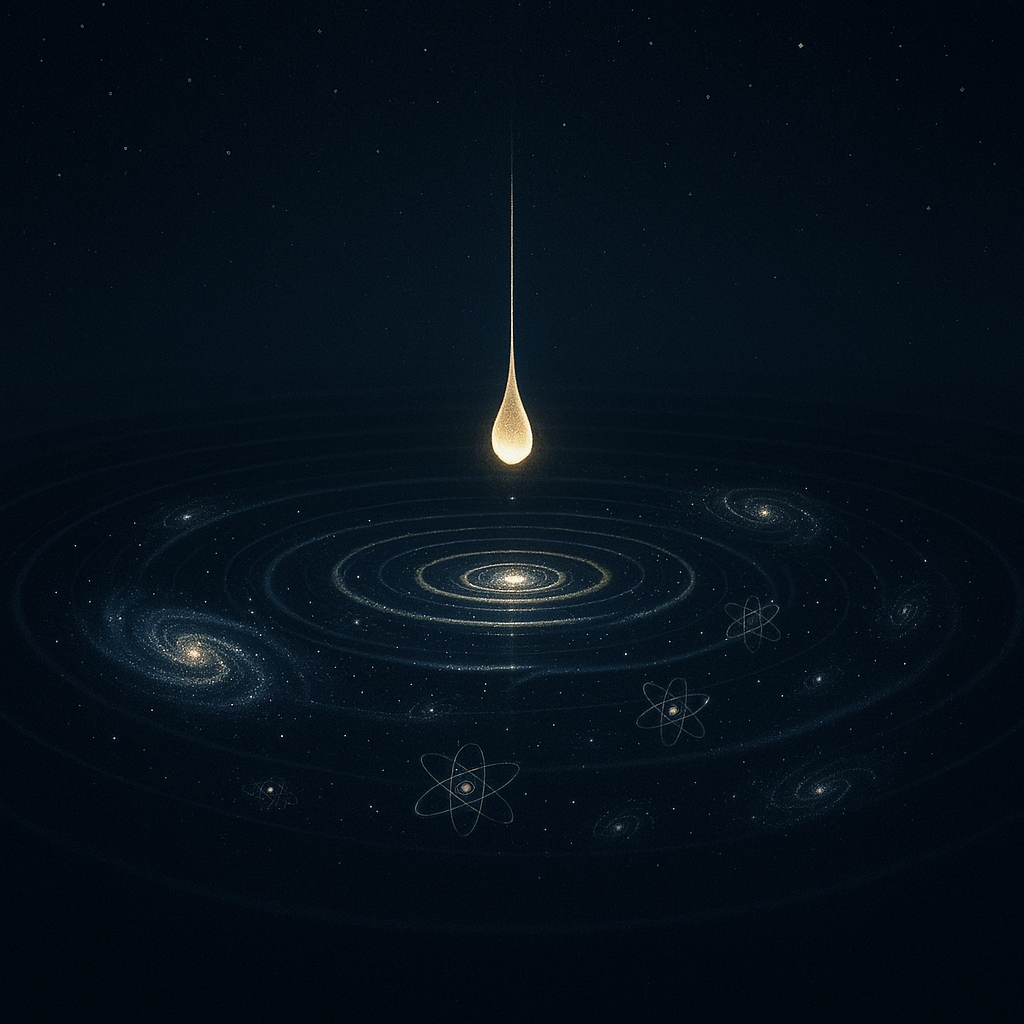
If every action leaves a trace, then the universe is listening. This essay explores how consequence, not illusion, proves reality, and how time itself may be the rhythm through which the real remembers its own becoming.
“Reality does not hide, it replies.”
1. The Question
Is reality real? Philosophers and physicists have chased this question for centuries. Some, from Bishop Berkeley to post-modern relativists, insist that what we call “reality” is only a projection of mind. Kant deepened the problem by separating the noumenon, the thing-in-itself, from the phenomenon we actually experience. Modern physics appears to agree: quantum experiments show that particles have no definite properties until observed. From Berkeley’s immaterialism to today’s headlines claiming “the universe is an illusion,” the idea that reality might be only perception has become fashionable.
Yet something resists that conclusion. The world answers us. Every act has consequence; every system produces effect. Reality is real, and consequence, the process of systems, shows us this.
2. Kant and the Shadow of the Noumenon
In the Critique of Pure Reason (1781), Kant argued that mind organizes experience through categories, space, time, causality. The “real” world behind experience is forever hidden. We meet only appearances shaped by the architecture of perception. His insight liberated modern philosophy but also left it haunted: if the thing-in-itself can never be known, what grounds the world we share?
Kant was right that perception is mediated, but he mistook mediation for separation. Experience is not a veil over reality; it is reality in process. When a storm breaks a tree, the consequence is not a phenomenon detached from noumenon, it is the noumenon expressing itself through process. Consequence is the evidence of the real.
3. Substance and Process
So what of the existence of the substances of which the world is made? Would that be actual reality, and are not the processes of systems equally real? The answer lies in their inseparability. Substance and process are two aspects of one continuum.
Matter, energy, and field form the substrate. Systems, the organized interactions among them, form the living motion of that substrate. Reality is both: being and becoming. To divide them is to freeze a river and then ask where the flow went.
Ludwig von Bertalanffy’s General System Theory (1968) described living and physical structures as open systems exchanging energy and information. Their stability arises not from static substance but from balanced flux, feedback, adaptation, consequence. In this systemic view, existence itself is self-organizing motion.
4. The Modern Challenge: Quantum Uncertainty
In 2022 Alain Aspect, John Clauser, and Anton Zeilinger received the Nobel Prize for demonstrating that the universe is not locally real. Their experiments on entangled photons violated Bell inequalities: measurements on one particle instantaneously influenced another, regardless of distance. “Objects,” it seemed, have no definite properties until measured.
Popular accounts turned this into a slogan: reality isn’t real. But that is a misreading. The experiments disprove local realism, not reality itself. They show that classical assumptions, objects as isolated substances with intrinsic properties, are incomplete. What remains undeniable is relationship: systems still produce consistent consequences. Entanglement is simply consequence without spatial limit. The fact that the pattern holds, measurable and repeatable, means reality continues to reply.
My own framework, the tri-system of instinct, emotion, and logic, absorbs this elegantly. Instinct perceives the tangible, emotion the relational, logic the conceptual. Quantum phenomena belong to the relational layer: information and connection behaving as one system across distance. The experiment does not abolish reality; it extends it beyond classical boundaries.
5. Consequence as Proof
Reality does not hide, it replies.
Reality may be elusive to definition, but it cannot hide from consequence.
Drop a stone – ripples form.
Speak a word – someone reacts.
If a tree falls and no one is there to hear it, no ear may register the sound,
but the consequence is undeniable.
When we later pass through the forest, the fallen trunk tells us it has spoken in its own way.
Every system, from atom to ecosystem, leaves trace and feedback.
This continuity of consequence is what binds existence into coherence.
Causality, questioned by quantum indeterminacy, survives as pattern: probabilities still sum to unity; laws still operate statistically. Stephen Palmquist’s study “Kantian Causality and Quantum Quarks” shows that even where individual events are uncertain, systemic consequence endures. The law of large numbers, entropy, and evolution all testify: process is reliable.
Thus, reality proves itself through response. If nothing were real, nothing would answer.
6. Time: The Measure of Consequence
Reality does not only reply in space; it replies in time.
Einstein revealed that time is not a universal river flowing evenly for all things. In his relativity, time is elastic, it stretches and compresses depending on speed and gravity. A clock on a mountain ticks faster than one at sea level; a traveller moving near light speed ages more slowly than those who remain behind. Time is not absolute, but it is real, because it measures change, because it measures consequence.
In everyday life the same principle holds, though we meet it through biology and consciousness rather than mathematics. A moment of fear seems to last forever; an hour of joy vanishes instantly. The clock is constant, yet our experience of consequence bends it. Emotional gravity and physical gravity both shape the rhythm of time.
So while Einstein showed that time is relative to motion and mass, we can add: time is also relative to meaning and relation. Each system experiences duration according to the density of its consequences, its energy, emotion, and connection to other systems. A cell divides in minutes, a human loves in decades, a species evolves in ages; each keeps its own honest time.
And if reality is ever in question, step into it. Stand before a moving bus and the universe will reply. The impact is the language of consequence, the body’s dialogue with momentum and mass. Your system will not only be altered; its ripples will reach others: the grief of loved ones, the investigations of strangers, the emotional field that follows. The physics is absolute; the meaning radiates outward. This is time made visible, consequence unfolding through connected systems.
Einstein described how motion and gravity bend the geometry of time; consciousness reveals how relation and emotion bend its texture. Together they show that time is neither illusion nor independent backdrop. It is the living record of consequence, the rhythm by which reality remembers itself.
7. Engaging the Illusionists
Contemporary “illusion” theories, such as Peter Kahl’s “The Illusion of Reality in a Computational Universe”, claim that reality is an emergent simulation within a deeper informational code. Yet even a simulation must run. Computation requires energy, order, and consequence. To call reality an illusion is to rename, not remove, its substance.
The same applies to popular spiritual idealism: the world as dream or hologram. Dreams still occur in brains; holograms require coherent light. The medium may be different from appearances, but consequence still binds them. If illusion produces consistent feedback, the illusion itself becomes real at its level of operation.
8. Individual and Collective Relativity
From the smallest particle to civilizations, every system carries its own tempo. Individually, time dilates with attention, emotion, or speed. Collectively, cultures accelerate or stagnate according to alignment. The health of a society depends on synchronization between its instinctive structures (economy, security), emotional culture (values, empathy), and logical institutions (law, science). When these fall out of rhythm, collective time fractures, progress in one domain, regression in another.
Thus the relativity of time is not only personal or physical; it is systemic. Each level of reality: particle, organism, culture, experiences consequence at its own pace. Reality is a polyphonic rhythm, not a single ticking clock.
9. Synthesis and Resolution
We can now answer both central questions.
(1) Is reality real?
Yes. Consequence proves it. Systems respond, interact, and evolve; effects follow causes. Even when quantum behavior challenges local determinism, the structure of consequence remains.
(2) What of the existence of the substances of which the world is made?
Substance and process are one continuum. The physical substrate, matter, energy, field, exists as potential. Process is that potential in motion. Both are actual reality, inseparable like body and pulse.
Time then appears as the connective tissue between them: the rhythm by which consequence unfolds. Einstein showed that physical time is relative to movement; consciousness reveals that experiential time is relative to coherence. In both domains, time is the signature of consequence, not its illusion.
10. Transitional Paragraph to the Conclusion
In this light, Einstein’s equations and human experience describe the same truth from different sides.
The physicist measures how matter bends time; the conscious being feels how consequence bends meaning.
Both reveal a universe that is relational rather than static, where space, time, and awareness are woven by interaction.
Every cause leaves its echo; every echo reshapes the pattern.
What physics calls curvature, consciousness calls memory.
Time, then, is not a container for events but the signature of connection, the living rhythm that proves reality and allows it to evolve.
11. Conclusion
Kant taught that we see only the shapes our minds allow; quantum physics warns that the universe is stranger than those shapes. Yet both overlook the simplest truth: the world replies. Reality announces itself through effect, through the ripples of its own existence.
To be is to participate in consequence.
To think is to notice it.
To be conscious is to understand that reality is not merely observed; it is co-created by the constant dialogue of substance, process, and time.
So yes, reality is real, and consequence, the process of systems, shows us this. Matter is the foundation, process the proof, and time the rhythm that binds them. Even when the universe hides its form, its echo remains, and that echo is reality speaking back.
Final Reflection: On Truth
So the question remains: does truth exist?
Yes, it exists in the inconsistencies of consistent consequence.
Every system wavers, adapts, and corrects; yet across all variation, cause still meets effect, response still follows action.
Truth is not a fixed statement but the pattern that endures through change, the reliability of consequence amid flux.
It is reality’s deeper symmetry: always imperfect in form, yet unwavering in return.
Select References
- Kant, Immanuel. Critique of Pure Reason. Cambridge University Press, 1998.
- Aspect, Alain; Clauser, John F.; Zeilinger, Anton. “Nobel Prize in Physics 2022 Press Release.” The Royal Swedish Academy of Sciences, 4 Oct 2022.
- Merali, Zeeya. “The Universe Is Not Locally Real, and the Physics Nobel Prize Winners Proved It.” Scientific American, 11 Oct 2022.
- Palmquist, Stephen R. “Kantian Causality and Quantum Quarks.” Philosophia Naturalis, Vol. 38 No. 1, 2001.
- Bertalanffy, Ludwig von. General System Theory. George Braziller, 1968.
- Einstein, Albert. Relativity: The Special and the General Theory. Crown, 1961 (1916).
- Kahl, Peter. “The Illusion of Reality in a Computational Universe.” Medium, 2020.
Leave a Reply